
Flowers. In San Remo they’re not a side note: they’re a grammar. You see them, of course — in the colours that punctuate the city, in the bouquets that appear at key moments, in the details that “give meaning” to a shot — but more than anything, you sense them. Because blooms here are not just imagery: they’re identity, work, season, and a kind of collective memory that returns every year along with the San Remo Music Festival.
There’s something people often miss when they watch the Festival from afar: flowers don’t arrive “by magic”. Behind them is a precise machine, made of people and tight timing. For the 2026 edition, several accounts highlighted exactly this direction work: the coordination entrusted to the San Remo Flower Market in Valle Armea, the selection of varieties, the design of the compositions, the logistics, and the installation across the official spaces of the San Remo Music Festival.
And then there are the numbers, which aren’t there to impress but to understand the scale: people spoke of tens of thousands of flowers destined for bouquets and displays linked to the week of the San Remo Music Festival. In parallel, the city lives on flowers even beyond the TV perimeter: pop-ups, shop windows, passageways that become small sets, with a declared choice of local and seasonal varieties.
Flowers as iconography: the gesture that says “San Remo” without explaining itself
The iconography of the San Remo Music Festival is made of recognisable things: the Ariston, the stairs, the lights. But flowers have a different quality: they enter the scene without demanding the centre. And precisely for that reason, they work. A bouquet offered at the right moment — without any need for commentary — manages to hold together three layers at once: the stage, the city, and the territory.
Here it’s worth challenging an easy assumption: it’s tempting to think flowers at the San Remo Music Festival are “just tradition”. In reality they’re also contemporary storytelling, because they change shape. They don’t always dominate the set design; often they concentrate in bouquets and in dispersed installations, with a daily composition work that, in some local accounts, reaches dozens of creations a day.
Flowers in the life of the city: the week when everything smells a little more
During the week of the San Remo Music Festival, flowers become an urban “tone”. It’s not only that you see more of them — it’s that gestures change. Walking into a hotel, crossing a corridor, grabbing a coffee in a crowded spot: everything feels slightly more curated. Flowers — with their concrete, fragile presence — remind you that San Remo isn’t simply hosting an event; it’s putting itself on display. And it does so in a language that needs no translation.
This is where smell matters more than we like to admit. Flowers aren’t only colour: they’re air. And air is exactly what remains when the screen goes dark. The San Remo Music Festival ends, but the atmosphere sticks to you in the most intangible details: a vegetal trace, a green note, a clean and luminous impression that carries the memory of those nights.
From the San Remo Music Festival to home: when flowers become a “signature”
If you try to translate this into a home setting, something interesting happens: you realise you don’t need to “recreate” San Remo. You need to recreate its balance. At its best, the San Remo Music Festival is a blend of energy and restraint. Flowers work the same way: present, but never invasive. And a home fragrance, when it’s done well, should do exactly that: sign a space without overpowering it.
A brief tour of Euthalia fragrances where flowers take the lead (or hide as a signature)
Muse Tuberose is the most theatrical case (in the best sense): a rich bouquet, where orange blossom, ylang ylang, tuberose and jasmine weave into a dense, sensual heart. Here flowers don’t create atmosphere: they create stage.
Jasmine and Berries works instead through contrast: the floral elegance of jasmine set inside a more enveloping context, between berries and warm spices. It’s very “an evening at the San Remo Music Festival”: brightness and comfort in the same gesture.
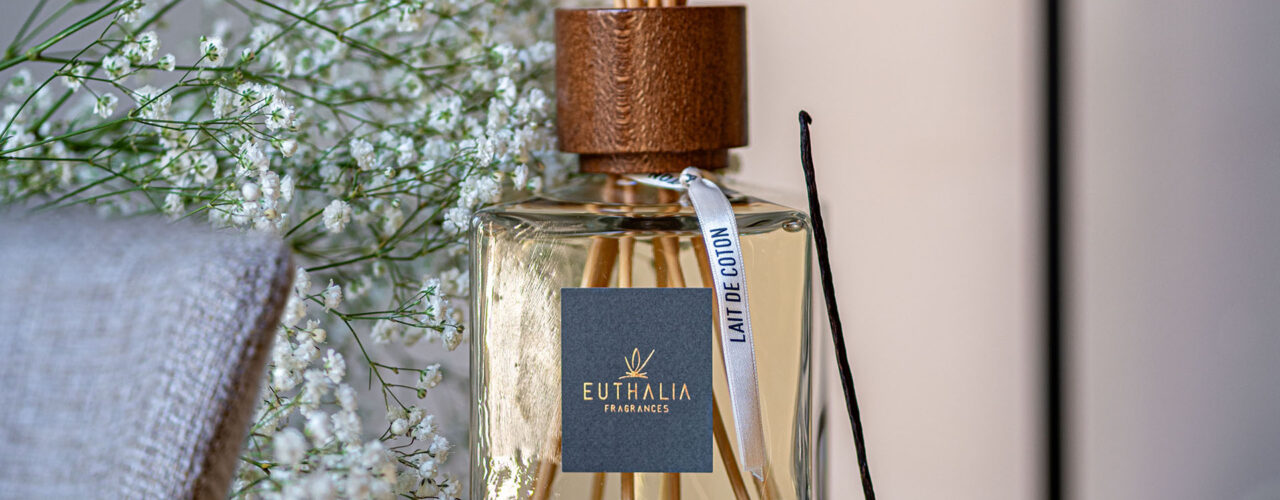
Lait de Coton places flowers on a more delicate register: cotton flower, violet and lily of the valley build a clean, soft sensation, almost textile. These are flowers that don’t seek attention, yet they change the air with discretion.
Fleur de Bali takes flowers and moves them toward a sunnier elsewhere: an idea of warm petals, luminous air, a sensual yet clean elegance — like a room changing its skin when the light comes in. It’s a fragrance that doesn’t “tell” a single flower: it tells a climate.
And then there’s Vanilla Peach, where a floral heart (violet, rose, ylang ylang, lily of the valley) accompanies the fruit with luminous grace: flowers as “finishing”, as an elegant seam that makes everything more harmonious.
Flowers, in the end, as a way of living
In San Remo and in the San Remo Music Festival — is something simple, but not banal: atmosphere is a choice. It doesn’t happen by accident. It’s built through repeated gestures, with a care that seems superfluous until you live it. Flowers are the clearest example: fragile, seasonal, concrete. And yet, when they enter the scene at the right moment, they make everything feel more real.
Maybe that’s why we like them so much: because flowers don’t explain, don’t prove, don’t insist. They stay. And they change the air. Exactly as a home fragrance should do when it doesn’t simply want to “perfume” a space, but to give character to a place.