

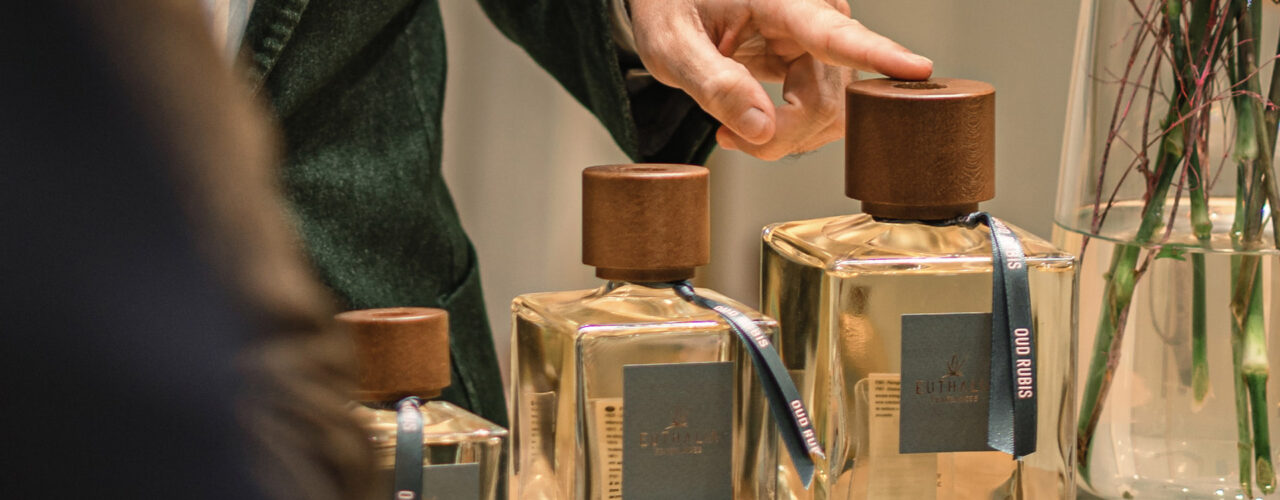
The size of Home diffuser is often chosen instinctively, guided by aesthetics, a preferred format, or simple habit. In reality, it is one of the most important aspects in creating a balanced, pleasant fragrance experience that truly suits the room..
A diffuser should not be chosen only because it looks beautiful or because it contains a fragrance we love. It should be proportionate to the space it is meant to inhabit. Scent, after all, does not remain confined within the bottle: it moves through the air, meeting walls, fabrics, furniture, air currents, and volumes. It needs space to express itself, but also restraint, so it does not become excessive.
A diffuser that is too small for a large room may lack presence. The fragrance is barely perceived, remains close to its point of origin, and then disperses without truly defining the atmosphere of the space. Conversely, an overly generous format in a compact room can feel intrusive, even when the olfactory composition itself is elegant.
The point, therefore, is not to choose “more fragrance”. It is to choose the right intensity.
Every Room Has Its Own Measure
When discussing home diffuser size, the first element to consider is, naturally, the size of the room. A bathroom, a small bedroom, a compact entrance hall, or a walk-in wardrobe does not require the same diffusion as a living room, dining area, or open-plan space.
In smaller rooms, a discreet presence is often enough. The fragrance does not need to make its way across a large volume: it quickly finds its place, settles gently in the air, and accompanies the room without requiring great diffusive power. In these cases, a smaller format may be not only sufficient, but also more refined. The fragrance remains perceptible without taking over the entire space.
In medium-sized rooms, however, a different balance is needed. The diffuser must be able to maintain continuity over time and make the fragrance recognisable even from a distance. It should not be perceived only when one approaches the reeds, but should contribute to the overall identity of the space.
When the room becomes larger, the choice changes again. A spacious living room, a dramatic entrance hall, a study with high ceilings, or a large day area requires more generous diffusion. Here, the fragrance must move through a greater volume of air, reach different points, and remain present even when the space is experienced in movement.
A Larger Format Is Not Always the Answer
There is, however, an important point: choosing the correct home diffuser size does not automatically mean selecting the largest format. That is an oversimplification, and it can lead to results that feel less harmonious.
In some interiors, especially large or articulated ones, it may be more effective to create multiple diffusion points. A large open-plan space, for example, is never truly a single environment. There may be a conversation area, a dining area, perhaps an open kitchen, a passageway, and an entrance that introduces the home. In these cases, one very large diffuser may create a strong presence near its placement point, but a less even perception throughout the rest of the space.
Two diffusers, positioned with care, can instead create a more natural diffusion. The fragrance does not come from one dominant source, but accompanies the space in a more balanced way. This is closer to the logic of interior design: a room is not always lit by a single central lamp; often, light is built through different points, depths, and accents. The same can happen with scent.
Fragrance then becomes an architectural presence, not merely an accessory.
Square Metres Matter, But They Are Not Enough
Another common mistake is to judge home diffuser size solely by square metres. Surface area matters, but it does not tell the whole story.
A twenty-square-metre room with a low ceiling and little air exchange will behave differently from a room of the same size with high ceilings, large windows, and frequent air movement. Materials also make a difference: curtains, sofas, rugs, wood panelling, bookcases, and fabrics can retain or soften the perception of a fragrance. Freer, cooler surfaces, on the other hand, may create a more airy and less enveloping impression.
The position of the diffuser is just as important. Placing it in a hidden corner, behind an object, or in an area with little natural air movement can limit its effectiveness. It is better to choose a stable, well-proportioned surface, not too enclosed, ideally in a place where the natural movement of air helps the fragrance circulate with delicacy.
This too is part of the choice. Size never works alone: it always enters into dialogue with the place in which it is placed.
Scent Should Belong to the Space
The best result is achieved when the fragrance seems to belong to the room. It should not impress with force, nor disappear after a few minutes. It should be recognisable without being intrusive; present without being insistent.
In a small room, measure means discretion.
In a medium-sized room, measure means continuity.
In a large room, measure means presence.
In a very large or professional space, measure can become a project.
For this reason, home diffuser size should be chosen with the same attention given to a furnishing piece. The format should also be visually coherent with the room. A small diffuser may be perfect on a bedside table, a shelf, or in an elegant bathroom. A more important format can enhance a console, an entrance hall, a central table, a reception area, or a showroom.
A reed diffuser is not only a container for fragrance. It is an object that enters the space and contributes to its atmosphere.
A Matter of Balance
Choosing the right home diffuser size means finding the point where fragrance, space, and intensity meet. There is no single rule that applies to every home, because every interior has its own air, its own arrangement, its own personality.
The most useful criterion is to observe the space: how large it is, how open it feels, how it is lived in, where people move, and what role we want the fragrance to play. Sometimes a more generous format is needed. Sometimes very little is enough. Sometimes the most elegant solution is not to increase the size, but to distribute the fragrance more intelligently.
Home fragrance works best when it does not feel added, but integrated. When it accompanies the entrance into a room, suggests its character, and completes its perception. It is a subtle form of decor: invisible, yet able to change the way a space is remembered.
And often, it all begins with a very concrete choice: the right diffuser size.